

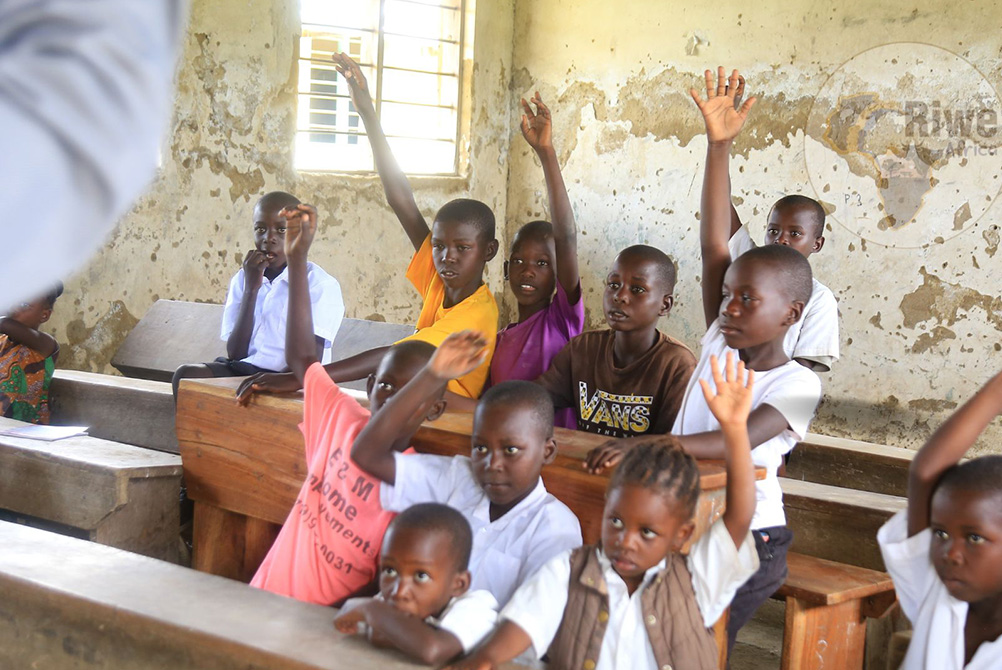
Education remains one of the biggest challenges in pastoralist communities in Uganda, with school enrollment rates significantly below the national average. Only 6 out of 10 children complete primary school, and less than 30% of these enroll in secondary education. Dropout rates escalate at the secondary level, where less than 15% of pastoralist youth transition to tertiary education. The mobility of pastoralist families, long distances to schools, early marriages among girls, limited infrastructure, and social-cultural norms prevent children, especially girls, from accessing formal education. Additionally, pastoralist youth lack access to vocational training opportunities, making it difficult to transition into stable and decent employment.
RIWE_AFRICA’s Education program focuses on providing affordable and quality education for pastoralist children and youth, particularly girls, who are often excluded from formal education. We work to close the education gap by improving access to learning opportunities and creating a more inclusive and equitable education system in these pastoral communities.
We address education challenges by working directly with pastoral communities, schools, the district local Governments, and other development partners to improve education infrastructure, provide teacher training, and promote gender-sensitive education policies. Our efforts include developing alternative learning pathways that accommodate the lifestyle of pastoralist families, such as community-based education initiatives and vocational training. Our work also includes advancing policies that support pastoralist education, improving school retention rates, and strengthening gender-responsive learning environments. We also work to raise awareness of the importance of education for girls and young women, encouraging families to invest in education in a pastoral girl child Education.
We primarily target pastoralist children (6-17 years), youth out-of-school, girls, young mothers, teachers, and parents, ensuring that education is accessible, equitable, and relevant to their unique needs.
Project Title: Back to Learning (B2L) pilot Project
Project Duration:
2025 – 2026
Other Partners:
Geographic Coverage:
Ntoroko District:
Target Population:
Floods Displaced Learners in Ntoroko District.
PROJECT GOAL
To support climate-affected and internally displaced pastoralist learners to recover lost learning time and successfully reintegrate into school through a structured, school and community-based Remedial Plus (R+) Education Model.
Project Objectives
Support climate-displaced and vulnerable host-community learners to recover lost learning time and reintegrate into host community schools.
Strengthen teacher capacity to deliver inclusive, learner-centred instruction for displaced and other vulnerable learners in host community schools.
Build foundational digital literacy skills among learners and strengthen parental involvement in supporting learning recovery at home.
DETAILED PROJECT DESCRIPTION
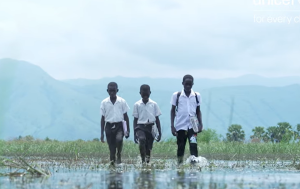
The B2L project is a pilot learning recovery and reintegration initiative designed to respond to education disruption caused by climate-induced displacement in Ntoroko’s pastoral communities using the Remedial Plus Education model. The model is being tested in 2 primary schools (Nyakasenyi primary school in Butungama and Rwangara primary school on the resettlement camp in Kanara sub-country, Ntoroko District. Recurrent flooding from Lake Albert has displaced thousands of households, forcing learners to abandon their schools and re-enroll in host-community schools after prolonged absence. While re-enrolment restores access, many displaced learners struggle with learning loss, irregular attendance, stigma and trauma associated with displacement, and reduced confidence in the classroom.
RIWE_AFRICA implements B2L to support both internally displaced learners and vulnerable learners from host communities. The programme provides structured remedial education sessions conducted after school hours, focusing on literacy and numeracy recovery aligned to the national primary school curriculum. Learners are grouped based on learning needs rather than grade level, enabling teachers to provide targeted support.
The B2L project is delivered by trained teachers who receive ongoing support from RIWE_AFRICA, in collaboration with the District Education Department, to strengthen inclusive and learner-centred teaching practices. A key innovation within the B2L project is the integration of digital literacy for upper-primary learners. Learners in Primary 6 and Primary 7 participate in twice-weekly digital learning sessions using tablets preloaded with offline educational content and learning games, designed to improve digital confidence, motivation, and readiness for technology-supported learning in low-connectivity environments.
Parental and caregiver engagement is embedded as a core community-based component of B2L. Through structured termly meetings, parents are supported to monitor attendance, assist with homework, and create safe and supportive home-learning environments, addressing non-academic barriers to learning recovery commonly faced by displaced households.
These adds on defines the models (Remedial Plus Education Model)
Scale-up plan.
RIWE_AFRICA plans to expand the Remedial Education model to additional host-community schools in flood-affected communities. The scale-up will focus on strengthening teacher training and peer learning, increasing access to digital literacy and blended learning, improving monitoring and learning outcome tracking, and investing in charging and digital infrastructure in off-grid communities
Project Title: International Peer Education and Mentorship (IPEM) Program.
Project Duration.
2024 – Ongoing
Technical Partner:
Peace Learning Center
Other Partners:
Geographic Coverage:
Ntoroko and Kasese Districts
Target Population:
PROJECT GOAL
To enhance academic performance, digital literacy, leadership skills, and global exposure for pastoralist secondary students by connecting them to international mentors through a secure online coaching platform.
Project Objective
DETAILED PROJECT DESCRIPTION
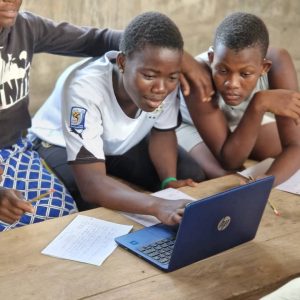
The International Peer Education and Mentorship (IPEM) program was launched in 2024 as a visionary education initiative designed to broaden the horizons of pastoralist secondary school learners. Implemented in partnership with peace learning Center in the USA, the program bridges local students with international mentors from across Africa and the USA, using a secure online mentorship platform.
With guidance and oversight from RIWE-AFRICA and Peace learning Center, Local learners are paired with their international peers for mentorship and individualized guidance in areas such as:
The IPEM addresses a key gap in pastoralist communities that limits access to role models, career guidance, and digital learning opportunities. Through the integration of structured virtual coaching sessions, learners build self-confidence, improve classroom participation, and gain motivation to pursue higher aspirations.
The program also supports digital skill development by introducing learners to online communication platforms, virtual learning tools, and collaborative digital spaces for practical skills that are essential for education and employment in the 21st century.
The partnership with Peace learning center has strengthened the program with expertise in youth leadership, conflict resolution, social-emotional learning, and global citizenship education.
To Date, over 70 secondary learners have been enrolled. We notice Improved class performance, especially in subjects requiring analytical and communication skills. There is also increased digital literacy as learners gain confidence using online learning tools. This has also boosted confidence and self-expression, with students reporting better participation in class activities. It strengthens aspirations and provides greater exposure to global opportunities
Our Future Plans include scaling IPEM to additional secondary schools in pastoralist districts, introducing group mentorship sessions on leadership, career development, and life skills, and strengthening digital infrastructure in rural schools to improve the mentoring experience.